
As movie fans, we naturally want the films we love to thrive, both critically and commercially. So when a genuinely special cinematic experience bombs at the box office, it’s painful to watch. For the past week, I haven’t been able to stop thinking about Forgotten Island’s dismal opening weekend, recouping just $20 million of its $80 million budget. Despite rave reviews, including my own 9/10, audiences simply aren’t showing up for what is easily one of DreamWorks‘ best films to date, right alongside The Wild Robot.
But rather than point fingers, let’s look on the bright side. Box office numbers rarely measure true quality, and history is full of theatrical misfires that went on to become absolute classics. From Death to Smoochy to Fear and Loathing in Las Vegas, some of my favorite movies of all time were financial flops. With that in mind, let’s revisit other brilliant animated films that stumbled in theaters, only to become some of the genre’s brightest gems.

Kubo and the Two Strings
I don’t want to hear another word about how stop-motion animation struggles to compete against mainstream CGI blockbusters when it comes to this emotional, hand-crafted masterpiece. Audiences completely dropped the ball on LAIKA Studios’ 2016 samurai epic, Kubo and the Two Strings, despite a powerhouse voice cast featuring Charlize Theron, Matthew McConaughey, and Ralph Fiennes. The painstaking effort required to create any of LAIKA’s awe-inspiring features would make your average studio executive’s head spin. Still, Kubo possesses an extra dollop of that special sauce that makes their output bold, unique, and vastly superior to most big-ticket animated items on display. From the staggering, sixteen-foot-tall Giant Skeleton puppet – the largest stop-motion figure ever built – to the breathtakingly intricate origami sequences that breathe life into Travis Knight’s mythical feudal Japan, every single frame demands reverence. Yet instead of investing in the future of industry-defining stop-motion craftsmanship, mainstream audiences would rather offer the mouse another hunk of Pule cheese than support a project in which dedicated artists move puppets a fraction of an inch for years on end just for our entertainment. Where’s the Game of Thrones “Shame Nun” when you actually need her?
What hurts the most is that Kubo and the Two Strings isn’t just a technical flex; it’s a profoundly moving exploration of grief, memory, and the enduring power of storytelling that runs circles around the assembly-line narrative formulas clogging up modern multiplexes. Dario Marianelli’s sweeping, shamisen-led score carries an emotional weight that anchors Kubo’s tragic quest, balancing genuine mythological terror with a quiet, poetic grace that trusts its audience enough to engage with complex themes of loss and legacy. Watching a film this visually revolutionary and narratively rich struggle to clear $77 million globally, despite a $60 million budget, remains an absolute travesty, a stark reminder of how severely moviegoers underappreciate a true cinematic triumph. LAIKA poured their absolute heart and soul into creating an immortal fable, only to have it relegated to cult status. At the same time, cookie-cutter CGI sequels raking in billions is a stain on modern film discourse that I won’t be forgiving anytime soon.

Fantastic Mr. Fox
In Wes Anderson’s Fantastic Mr. Fox, an urbane fox cannot resist returning to his farm-raiding ways, forcing his community to survive the farmers’ ruthless retaliation. Co-written with Noah Baumbach and based on Roald Dahl’s 1970 novel, the film is a brilliant exploration of class struggle, wild nature, and community resilience.
George Clooney flawlessly voices Mr. Fox in an ongoing war against high-rolling farmers who keep “wild animals” in their place. While it channels a classic Robin Hood energy, Anderson pushes deeper into the desire to escape mediocrity. The film remains deeply relatable today as the real world continues to struggle with equality and building a society that lifts its neighbors rather than forcing them to scrounge in the dirt.
Given those sharp thematic echoes, it’s painful that Fantastic Mr. Fox only scraped together $46.5 million worldwide against a $40 million budget. Heavy holiday competition – including The Twilight Saga: New Moon, Disney’s A Christmas Carol, 2012, and Avatar – certainly didn’t help. Fortunately, the underperformance didn’t scare Anderson away from stop-motion, as 2018’s Isle of Dogs went on to earn $73 million on a leaner $35 million budget.

The Iron Giant
It’s hard to wrap your head around The Iron Giant flopping at the box office, especially knowing Brad Bird went on to direct Pixar’s $631 million blockbuster, The Incredibles. Still, in 1999, Warner Bros. failed to recognize the film’s potential before it was too late to mount a marketing push worthy of its greatness. Produced on a $50 million budget, the animated sci-fi classic grossed just $31.7 million worldwide—despite near-universal acclaim and an “A” CinemaScore. These days, audiences swear by The Iron Giant as one of the most heartwarming animated movies ever made. Where was this energy in 1999?
Although Brad Bird has taken his share of the blame, the fault lies squarely with Warner Bros. The studio lost confidence in 2D animation after Quest for Camelot underperformed, prematurely viewing traditional animation as a relic of the past rather than a timeless art form. While its original run was cut short, The Iron Giant has rightfully become a beloved classic, proving that true craftsmanship stands the test of time regardless of box-office receipts.

Batman: Mask of the Phantasm
Given how iconic Batman: The Animated Series is, it’s wild to think a spin-off movie from the same team flopped at the box office. Batman: Mask of the Phantasm was originally planned as a direct-to-video release, but executives were so blown away by early footage that they rushed it into theaters. Sadly, an eight-month production crunch and a weak marketing push doomed its theatrical run.
The film blends two converging storylines as a scythe-wielding vigilante, the Phantasm, begins taking down Gotham mob bosses. With the GCPD blaming Batman for the killings, Bruce Wayne has to untangle his past to preserve his future as the city’s protector. Anchored by Shirley Walker’s sweeping score, a deep emotional arc for Bruce, and stellar performances from Kevin Conroy, Mark Hamill, Dana Delany, and Stacy Keach, Mask of the Phantasm easily stands as one of the Caped Crusader’s finest cinematic achievements.
Atlantis: The Lost Empire
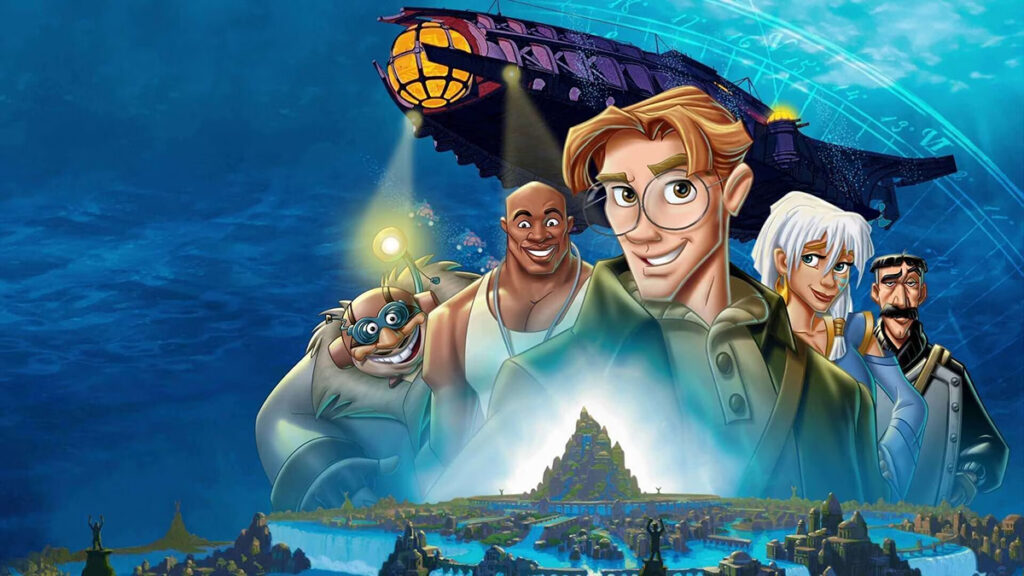
Atlantis: The Lost Empire earns the final spot on this list because it’s a bit of an anomaly. While it pales in comparison to Disney’s 1990s Renaissance hits, it wasn’t a complete financial failure. Costing roughly $90–$120 million, the animated sci-fi spectacle—starring Michael J. Fox, Jim Varney, and Cree Summer—grossed $186 million worldwide and pulled in an extra $157 million on home video in its first two years. Yet, given its ambitious scope, Atlantis should have been a much bigger blockbuster.
What makes Atlantis special is how boldly it rejects the classic Disney musical formula. Instead, it delivers a Jules Verne–inspired action-adventure featuring distinctive character and creature designs from Hellboy creator Mike Mignola. It also marked a pivotal transition for Disney, seamlessly blending hand-drawn 2D animation with CGI elements. The result is a high-octane underwater adventure that pushed the studio far outside its comfort zone. Though underappreciated in 2001, Disney’s 41st animated classic delivers a striking, style-forward thrill ride that holds up remarkably well today.
What other box office flops do you think are stone-cold classics? Let us know in the comments section below!
Source: JoBlo
Long-form article body was supplied directly by the publisher RSS feed.